ASVAB Test / Practice tests / MC
ASVAB Mechanical Comprehension practice test
10 free questions · scored as you go · every answer explained
Levers, pulleys, gears, pressure and force: how machines move. Key for mechanical jobs. On the computer-based ASVAB you get 15 Mechanical Comprehension questions in 22 minutes, about 1.5 minutes per question. It does not count toward your AFQT, but the services use it to qualify you for certain jobs.
Your score
0/ 10
Practice scores from original questions, not official ASVAB scores. ASVAB Test is not affiliated with the U.S. Department of Defense.
-
MCMechanical Comprehension1 of 10
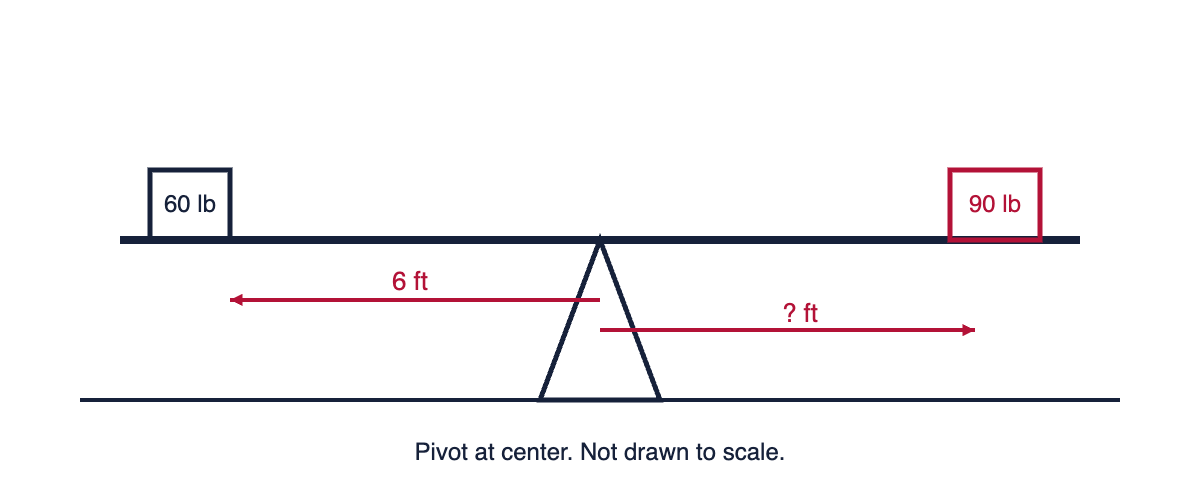
Refer to the figure. A 60-pound child sits 6 feet from a seesaw's pivot. How far from the pivot must a 90-pound child sit on the other side to balance it?
Show answer
Answer: A. 4 feet
Balance needs equal moments on both sides: 60 × 6 = 360 pound-feet, so the heavier child needs 360 ÷ 90 = 4 feet. Heavier riders sit closer to the pivot.
-
MCMechanical Comprehension2 of 10
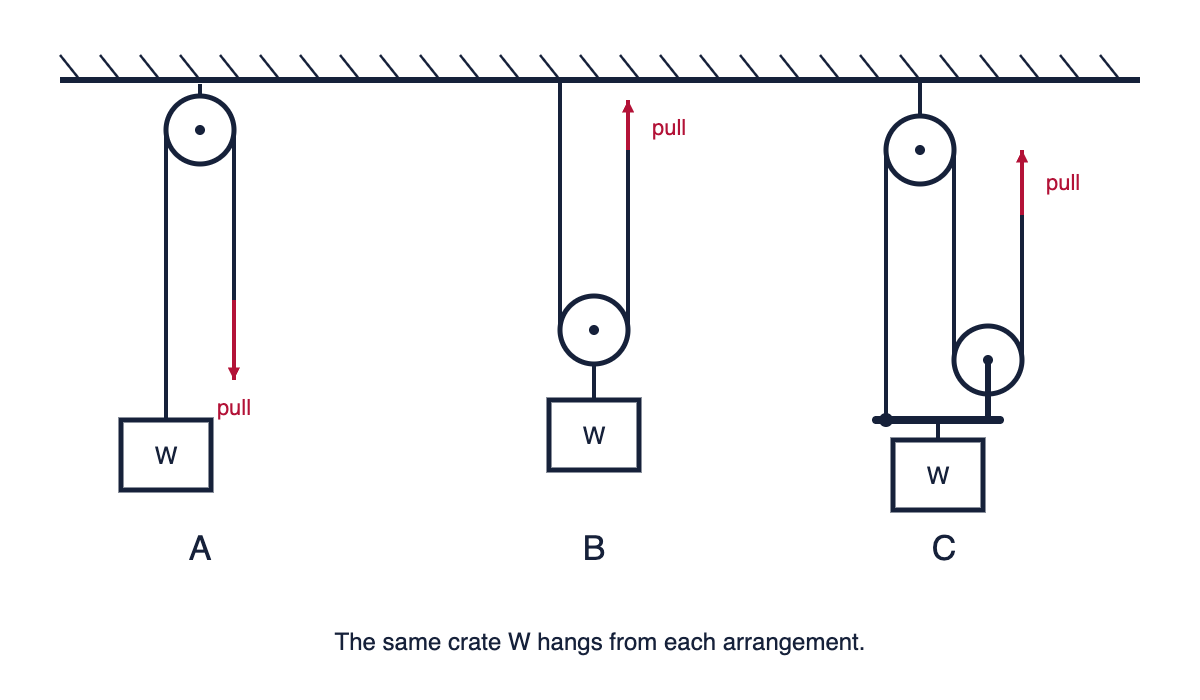
Refer to the figure. Arrangements A, B and C lift the same crate. Which setup needs the least pull on the rope?
Show answer
Answer: C. C, because more rope sections share the load
Mechanical advantage equals the number of rope sections supporting the load: A has one (it only changes direction), B has two, C has three. More supporting sections mean less pull — but more rope to haul.
-
MCMechanical Comprehension3 of 10
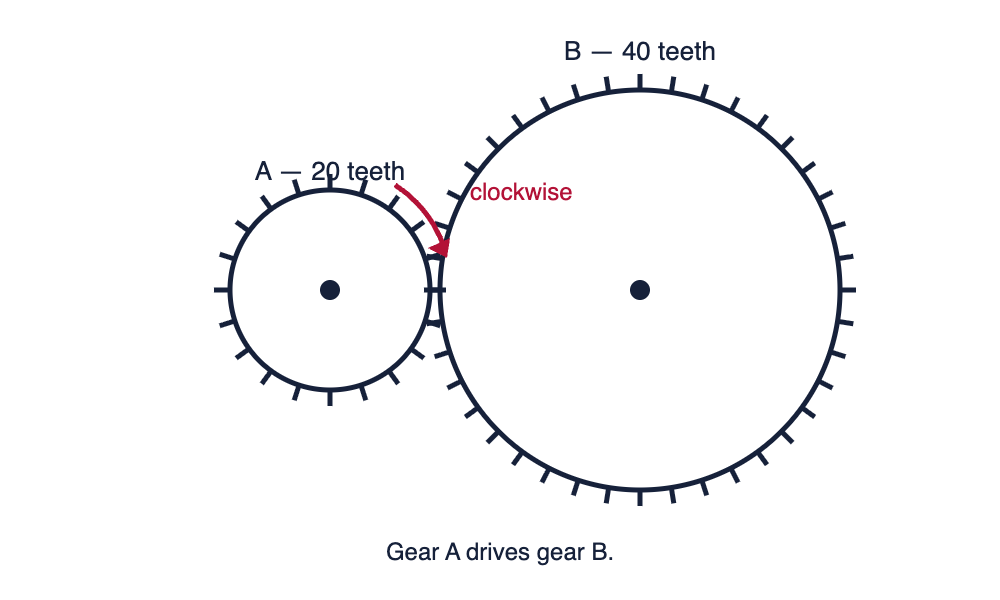
Refer to the figure. Gear A (20 teeth) meshes with gear B (40 teeth). If gear A turns clockwise, gear B turns:
Show answer
Answer: A. Counterclockwise, at half the speed of A
Meshed gears always turn in opposite directions. Speed is inversely proportional to teeth: with twice the teeth, B turns at half A's speed, but with twice the torque.
-
MCMechanical Comprehension4 of 10
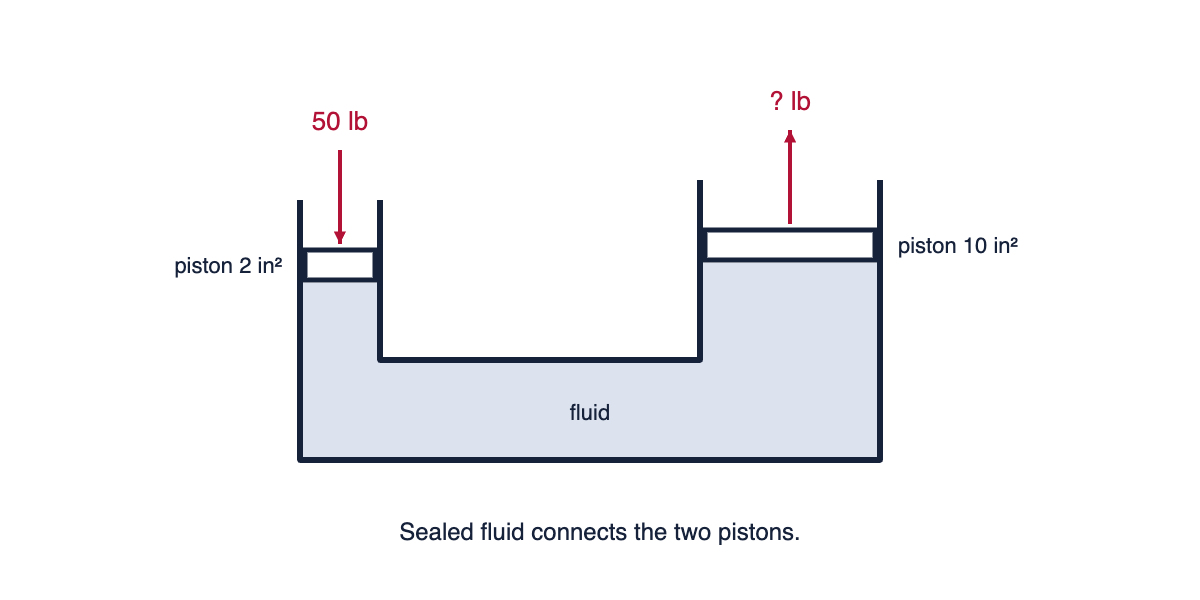
Refer to the figure. A hydraulic press has a 2-square-inch input piston and a 10-square-inch output piston. Pushing down with 50 pounds lifts how much on the output side?
Show answer
Answer: D. 250 pounds
Pressure transmits equally through the fluid (Pascal's principle): 50 ÷ 2 = 25 psi, and 25 × 10 = 250 pounds. The price is distance — the small piston must travel five times as far.
-
MCMechanical Comprehension5 of 10
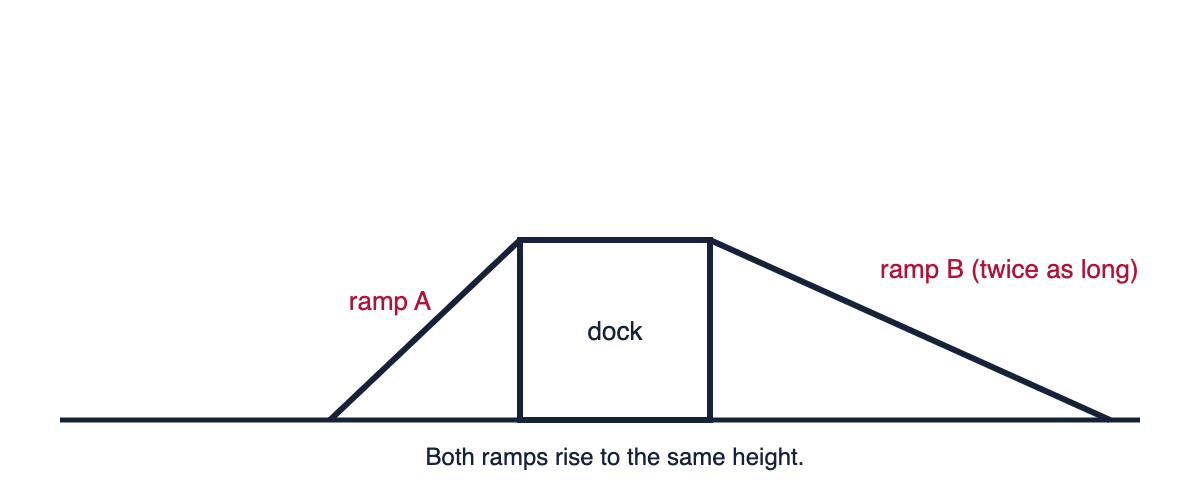
Refer to the figure. Ramps A and B rise to the same loading dock. Ramp B is twice as long as ramp A. Ignoring friction, pushing a crate up ramp B takes:
Show answer
Answer: B. About half the force needed on ramp A
An inclined plane trades distance for force: mechanical advantage is length ÷ height. Twice the length to the same height means half the force — though the work done is the same.
-
MCMechanical Comprehension6 of 10
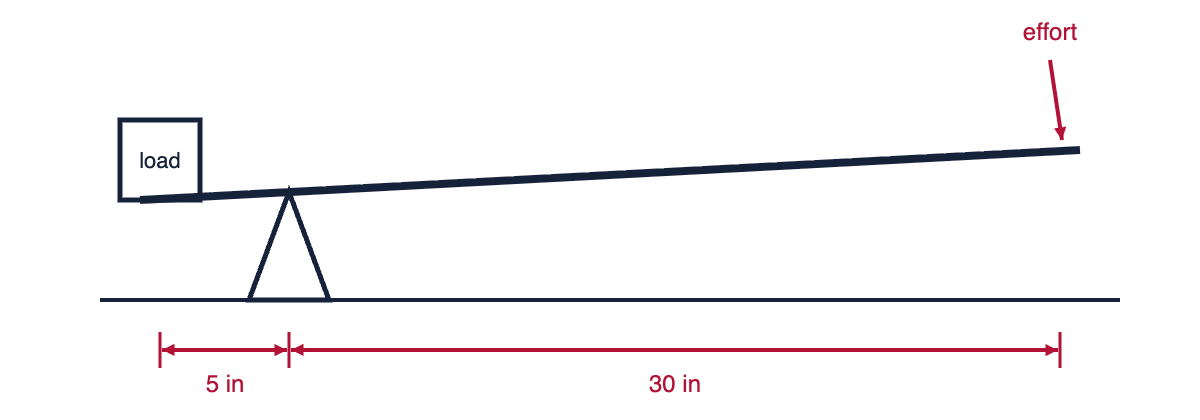
Refer to the figure. A pry bar is set so the distance from hand to fulcrum is 30 inches and from fulcrum to load is 5 inches. What is its mechanical advantage?
Show answer
Answer: C. 6
Mechanical advantage is effort arm ÷ load arm: 30 ÷ 5 = 6. A 50-pound push can move a 300-pound load — the long arm moves farther so the short arm pushes harder.
-
MCMechanical Comprehension7 of 10
A wheelbarrow is which class of lever?
Show answer
Answer: D. Second class — the load sits between the wheel (fulcrum) and your hands (effort)
Fulcrum at the wheel, load in the tray, effort at the handles: fulcrum-load-effort is a second-class lever, which always multiplies force. A seesaw is first class; tweezers are third class.
-
MCMechanical Comprehension8 of 10
Compared with coarse threads, a screw with fine (closely spaced) threads:
Show answer
Answer: C. Takes more turns to drive but needs less force per turn
A screw is an inclined plane wrapped around a shaft. Finer threads make a gentler slope: more rotations to advance the same distance, but each turn is easier and holds more precisely.
-
MCMechanical Comprehension9 of 10
A 10-kilogram cart must accelerate at 3 meters per second squared. How much force is required?
Show answer
Answer: B. 30 newtons
Newton's second law: F = ma = 10 × 3 = 30 newtons. Force scales with both mass and the acceleration demanded.
-
MCMechanical Comprehension10 of 10
Sliding friction between a crate and the floor depends mainly on:
Show answer
Answer: A. The weight pressing the surfaces together and their roughness
Friction is the normal force times the friction coefficient of the two surfaces. Surprisingly, contact area barely matters: a crate on its side slides about as hard as on its end.
What Mechanical Comprehension covers
The facts and methods behind the questions, from the app's study notes. Questions on test day are different, but they test the same things.
Simple machines
Simple machines: levers, pulleys, gears and wheels, ramps, screws and wedges — and the price every one of them charges.
- Levers. MA = effort arm ÷ load arm; balance = weight × distance equal on both sides. Classes: 1st fulcrum-middle (seesaw, reverses direction), 2nd load-middle (wheelbarrow, multiplies force), 3rd effort-middle (tweezers, multiplies speed).
- Pulleys. MA = rope sections supporting the load. Fixed pulley = 1 (changes direction only); movable = 2; block and tackle = more. MA 4 lifts with ¼ force but hauls 4× the rope.
- Gears, wheels, belts. Meshed gears reverse direction; an idler between restores it. Speed is inverse to teeth (10T at 100 RPM drives 50T at 20 RPM, 5× torque). Belted pulleys keep direction; bigger turns slower. Steering wheels and doorknobs are wheel-and-axle levers.
- Ramps, screws, wedges. Ramp MA = length ÷ height — twice the length, half the force. A screw is a wrapped ramp: finer threads, more turns, less force. Axes and chisels are wedges. Valves open counterclockwise.
Forces and motion
Forces and motion: F = ma, friction and stability, springs and torque.
- Newton applied. F = ma (10 kg at 3 m/s² needs 30 N). Everything falls at the same rate without air. Momentum = mass × velocity — why trucks stop long. Kinetic energy grows with speed SQUARED: double speed, quadruple energy.
- Friction and balance. Friction depends on load and surfaces, hardly on contact area; bearings swap sliding for rolling. Equal opposite pulls = equilibrium, no motion. Stability = low center of gravity + wide base.
- Springs and torque. Hooke’s law: stretch is proportional to force (10 lb per 2 in → 25 lb stretches 5 in). Springs in series add stretch; in parallel they share. Torque = force × lever arm: twice the wrench, twice the twist. Pendulum period depends on length, not weight.
Fluids, work and structures
Fluids, work and structures: pressure and hydraulics, work-energy-power, and how things carry load.
- Pressure and fluids. Pressure = force ÷ area (sharp knives, snowshoes). Pascal: hydraulic force scales with piston area — 50 lb on 2 in² lifts 250 lb on 10 in². Connected liquid levels equalize; siphons need the outlet below the surface; suction lifts at most ~34 ft of water. Floating = less dense. Heated sealed gas raises pressure.
- Work and power. Work = force × distance; power = work ÷ time. Machines trade force for distance — never less total work. Friction makes every machine under 100% efficient. Counterweights (elevators) let motors lift only the difference.
- Structures. Triangles are rigid — brace a sagging gate diagonally. Ropes carry tension, columns compression. Bridges need expansion joints (metal grows when hot — also why hot water frees a stuck lid). Shear pins break first on purpose, like mechanical fuses.
Keep going in the app. All 50 Mechanical Comprehension questions, 6 of them with diagrams, practice that brings back the ones you miss, and full exams timed subtest by subtest like the real test.
Practice the other subtests
Or take the full free practice test: 30 questions from all 10 subtests, with a rough AFQT estimate at the end.
These are original practice questions; real ASVAB items are confidential. Practice scores are estimates, not official ASVAB scores. ASVAB Test is not affiliated with the U.S. Department of Defense or any military branch.