ASVAB Test / Practice tests / AO
ASVAB Assembling Objects practice test
10 free questions · scored as you go · every answer explained
Spatial puzzles: see how parts fit together. Used mainly by the Navy for some ratings. On the computer-based ASVAB you get 15 Assembling Objects questions in 18 minutes, about 1.2 minutes per question. It does not count toward your AFQT, but the services use it to qualify you for certain jobs.
Your score
0/ 10
Practice scores from original questions, not official ASVAB scores. ASVAB Test is not affiliated with the U.S. Department of Defense.
-
AOAssembling Objects1 of 10
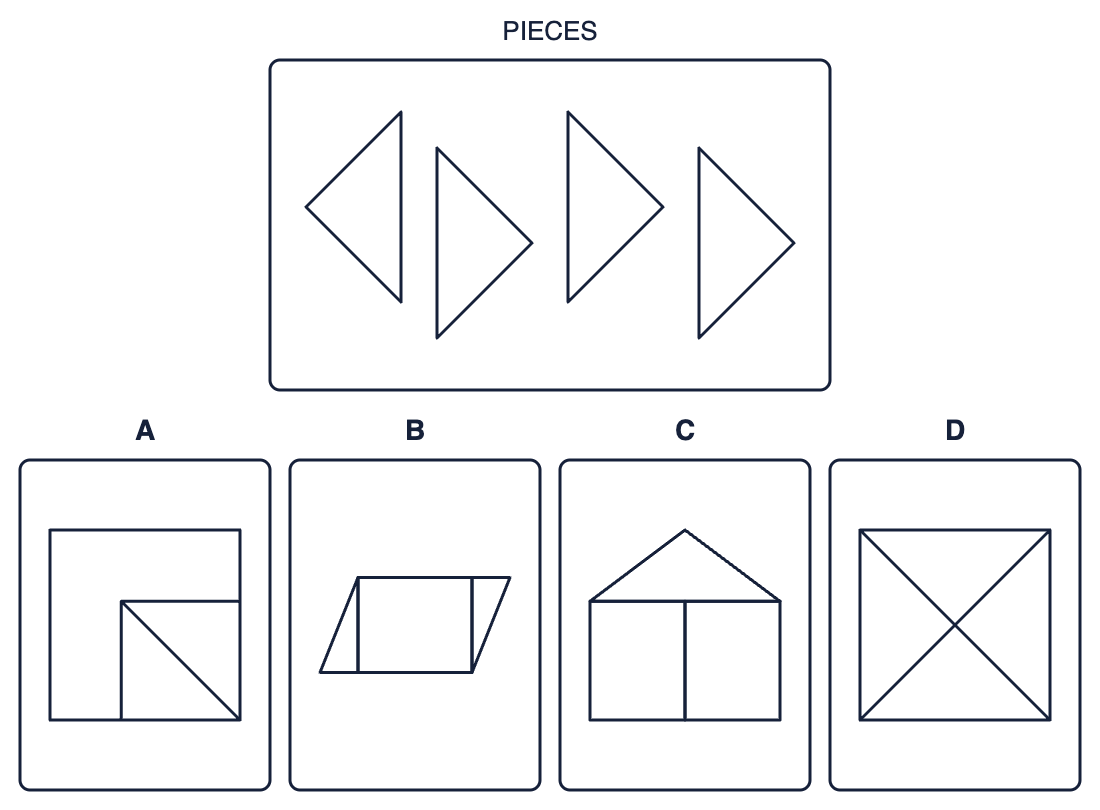
Refer to the figure (assembly puzzle 1). Which answer figure shows how the pieces in the box fit together?
Show answer
Answer: D. Figure D
The 4 pieces assemble into the square in figure D — every piece is used once, at its printed size, only rotated. Work from the largest piece: find the edge that matches its longest side, then check that the rest fill in without gaps or overlaps. The other figures are built from different pieces: even where an outline looks similar, the cuts inside don't match the pieces in the box.
-
AOAssembling Objects2 of 10
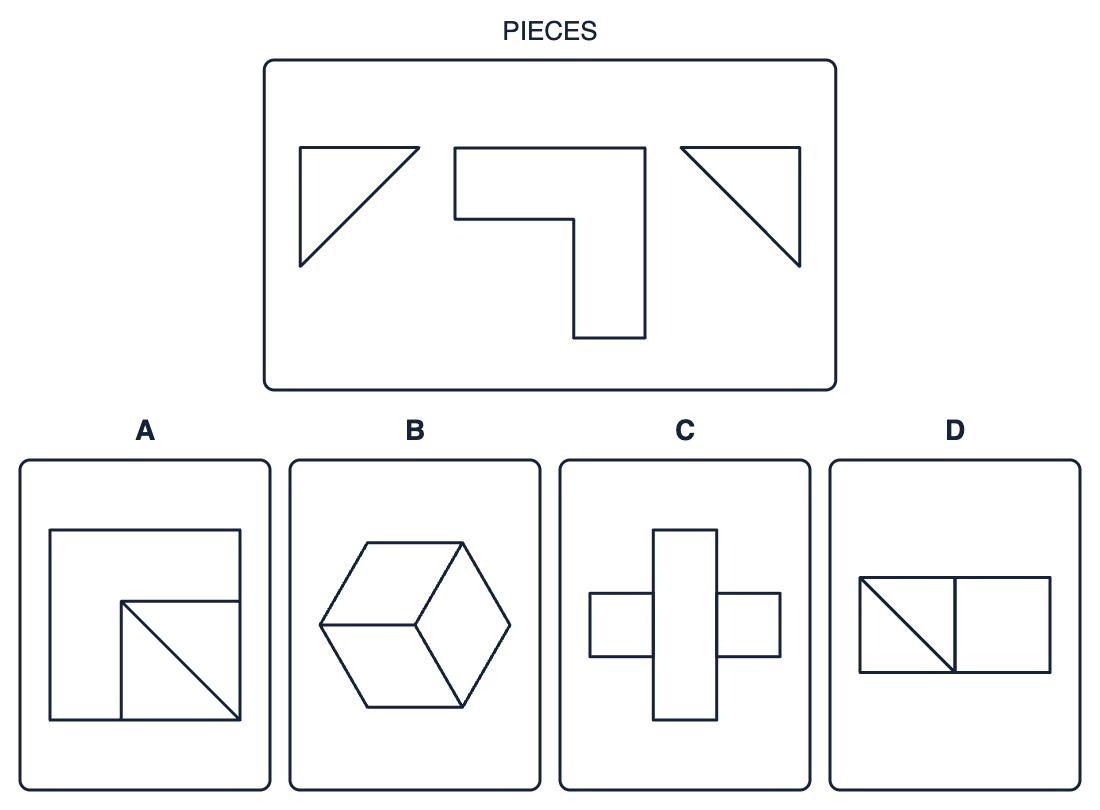
Refer to the figure (assembly puzzle 2). Which answer figure shows how the pieces in the box fit together?
Show answer
Answer: A. Figure A
The 3 pieces assemble into the square in figure A — every piece is used once, at its printed size, only rotated. Work from the largest piece: find the edge that matches its longest side, then check that the rest fill in without gaps or overlaps. The other figures are built from different pieces: even where an outline looks similar, the cuts inside don't match the pieces in the box.
-
AOAssembling Objects3 of 10
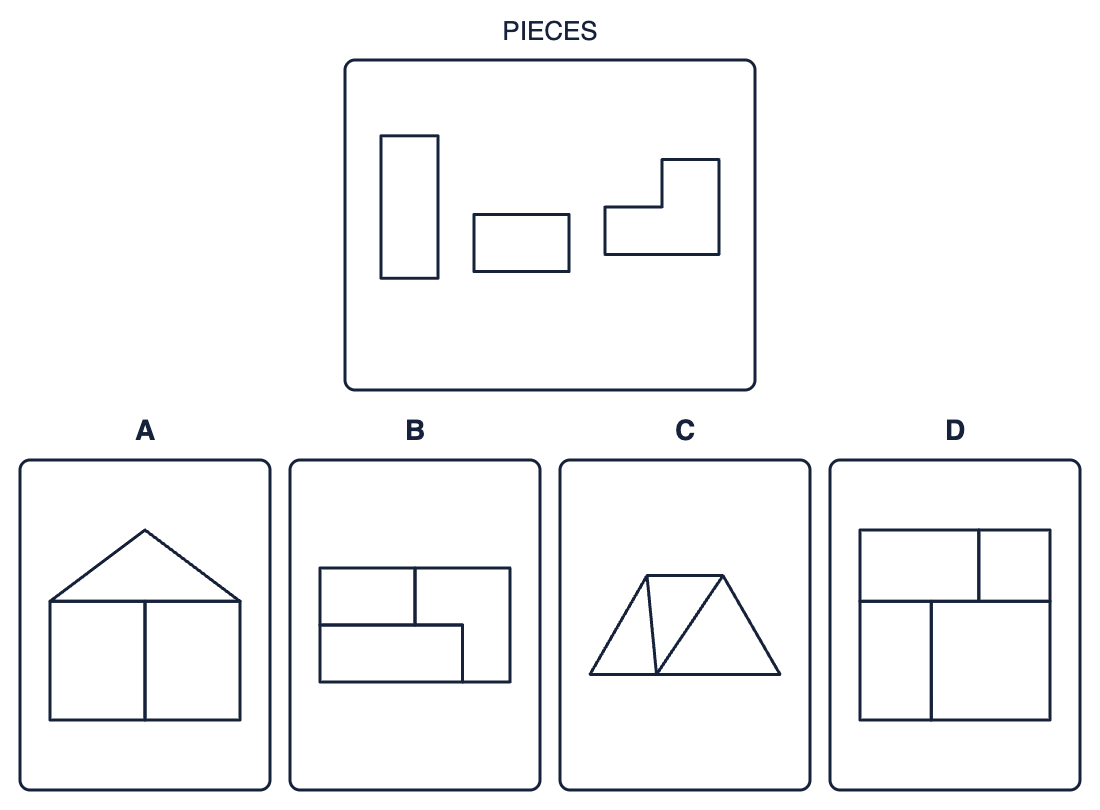
Refer to the figure (assembly puzzle 3). Which answer figure shows how the pieces in the box fit together?
Show answer
Answer: B. Figure B
The 3 pieces assemble into the rectangle in figure B — every piece is used once, at its printed size, only rotated. Work from the largest piece: find the edge that matches its longest side, then check that the rest fill in without gaps or overlaps. The other figures are built from different pieces: even where an outline looks similar, the cuts inside don't match the pieces in the box.
-
AOAssembling Objects4 of 10
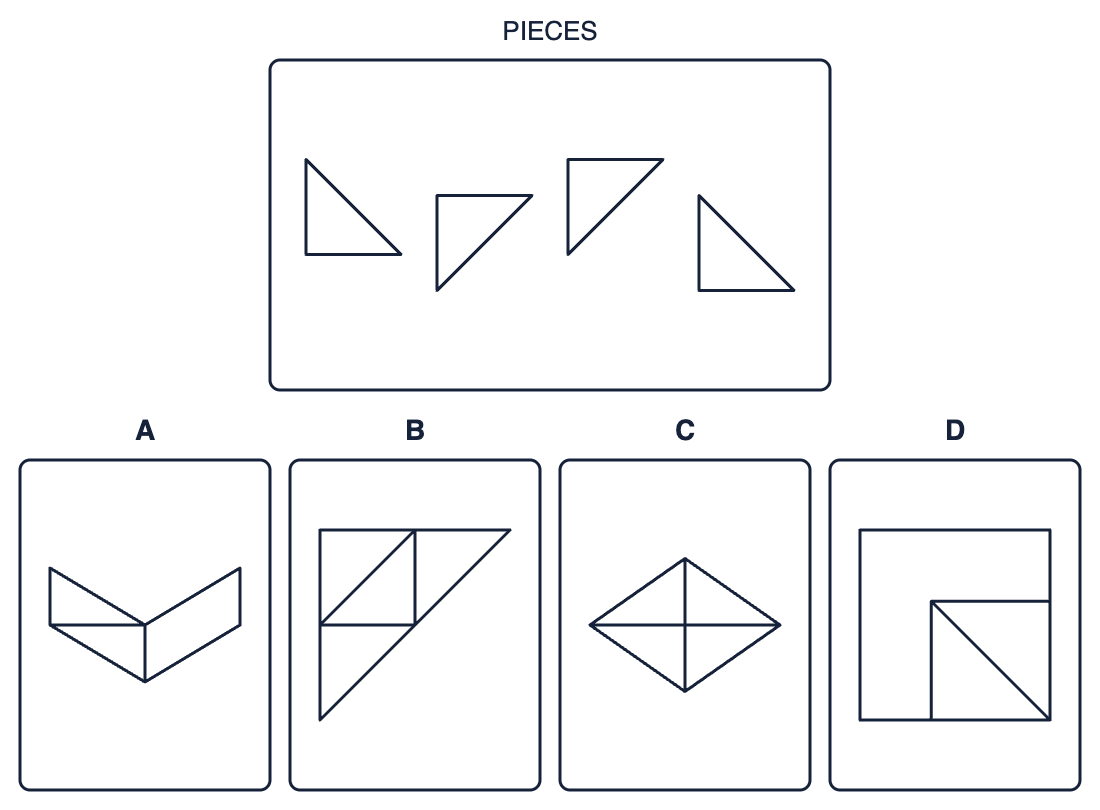
Refer to the figure (assembly puzzle 4). Which answer figure shows how the pieces in the box fit together?
Show answer
Answer: B. Figure B
The 4 pieces assemble into the large triangle in figure B — every piece is used once, at its printed size, only rotated. Work from the largest piece: find the edge that matches its longest side, then check that the rest fill in without gaps or overlaps. The other figures are built from different pieces: even where an outline looks similar, the cuts inside don't match the pieces in the box.
-
AOAssembling Objects5 of 10
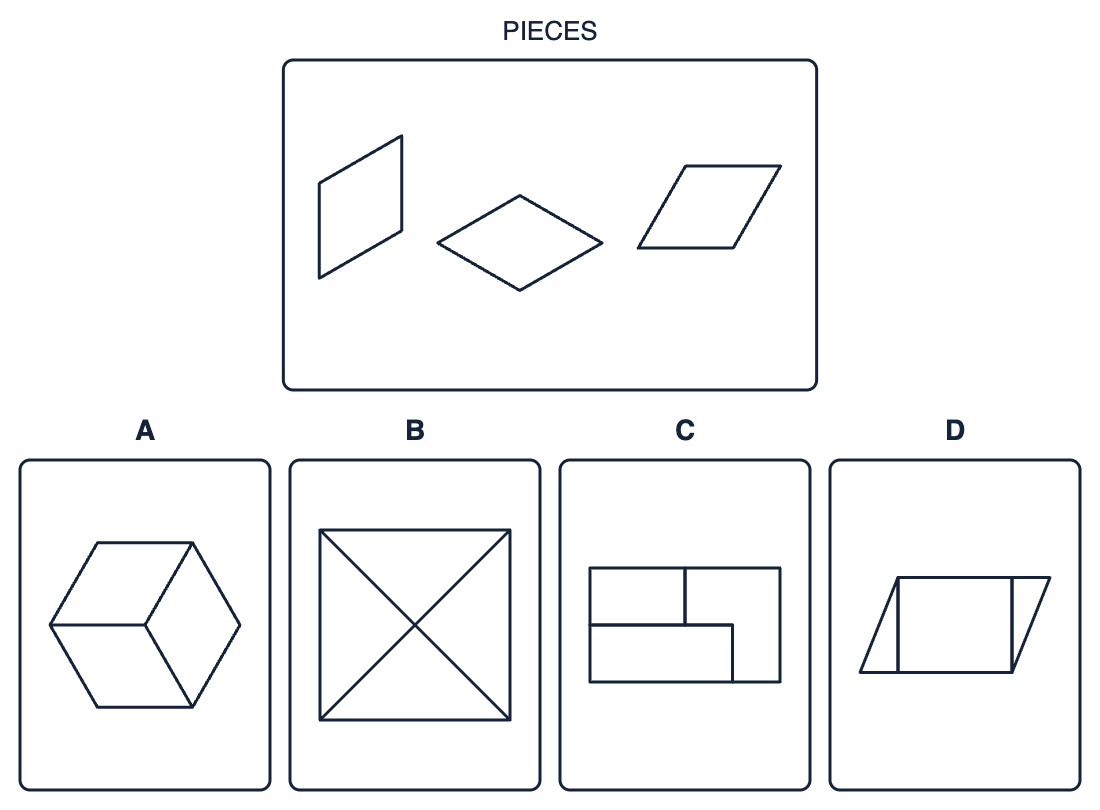
Refer to the figure (assembly puzzle 5). Which answer figure shows how the pieces in the box fit together?
Show answer
Answer: A. Figure A
The 3 pieces assemble into the hexagon in figure A — every piece is used once, at its printed size, only rotated. Work from the largest piece: find the edge that matches its longest side, then check that the rest fill in without gaps or overlaps. The other figures are built from different pieces: even where an outline looks similar, the cuts inside don't match the pieces in the box.
-
AOAssembling Objects6 of 10
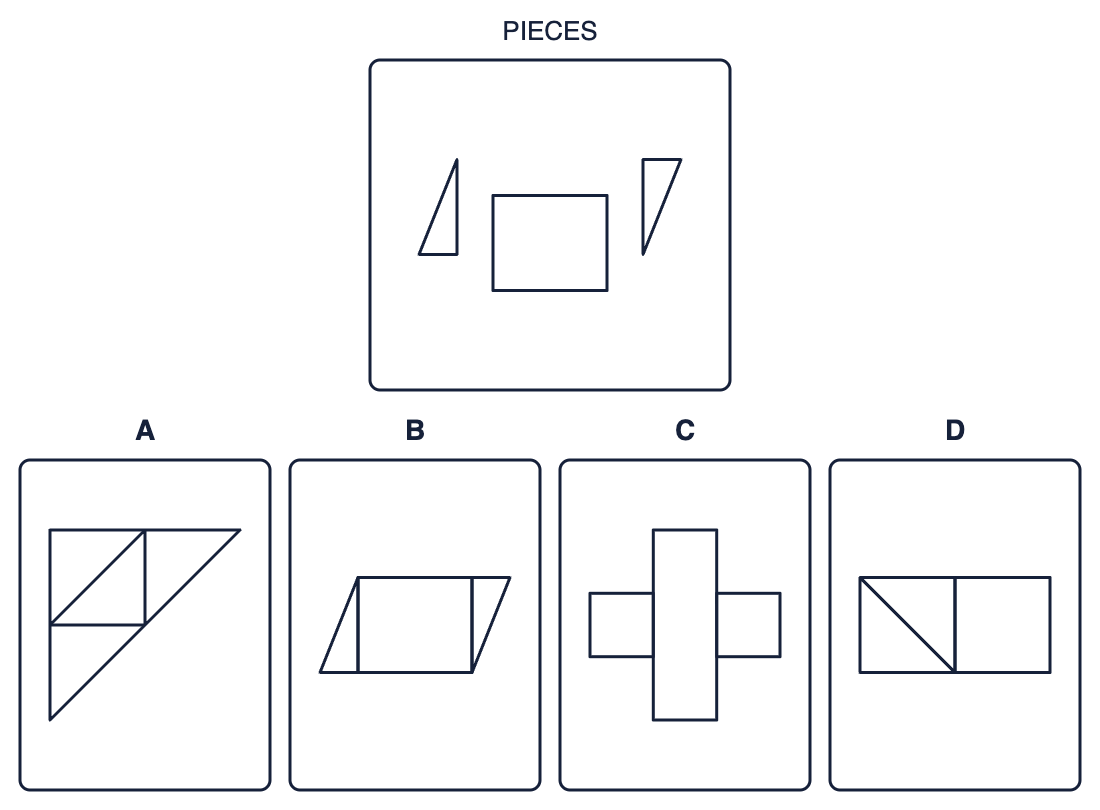
Refer to the figure (assembly puzzle 6). Which answer figure shows how the pieces in the box fit together?
Show answer
Answer: B. Figure B
The 3 pieces assemble into the parallelogram in figure B — every piece is used once, at its printed size, only rotated. Work from the largest piece: find the edge that matches its longest side, then check that the rest fill in without gaps or overlaps. The other figures are built from different pieces: even where an outline looks similar, the cuts inside don't match the pieces in the box.
-
AOAssembling Objects7 of 10
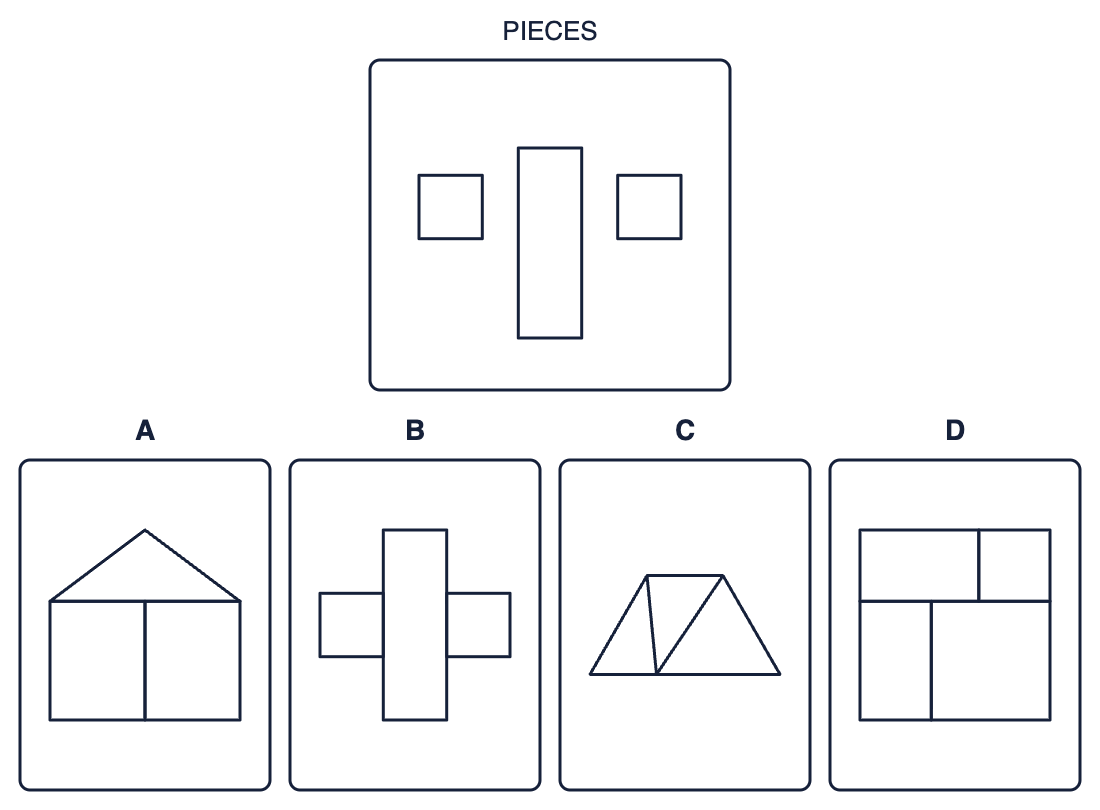
Refer to the figure (assembly puzzle 7). Which answer figure shows how the pieces in the box fit together?
Show answer
Answer: B. Figure B
The 3 pieces assemble into the plus shape in figure B — every piece is used once, at its printed size, only rotated. Work from the largest piece: find the edge that matches its longest side, then check that the rest fill in without gaps or overlaps. The other figures are built from different pieces: even where an outline looks similar, the cuts inside don't match the pieces in the box.
-
AOAssembling Objects8 of 10
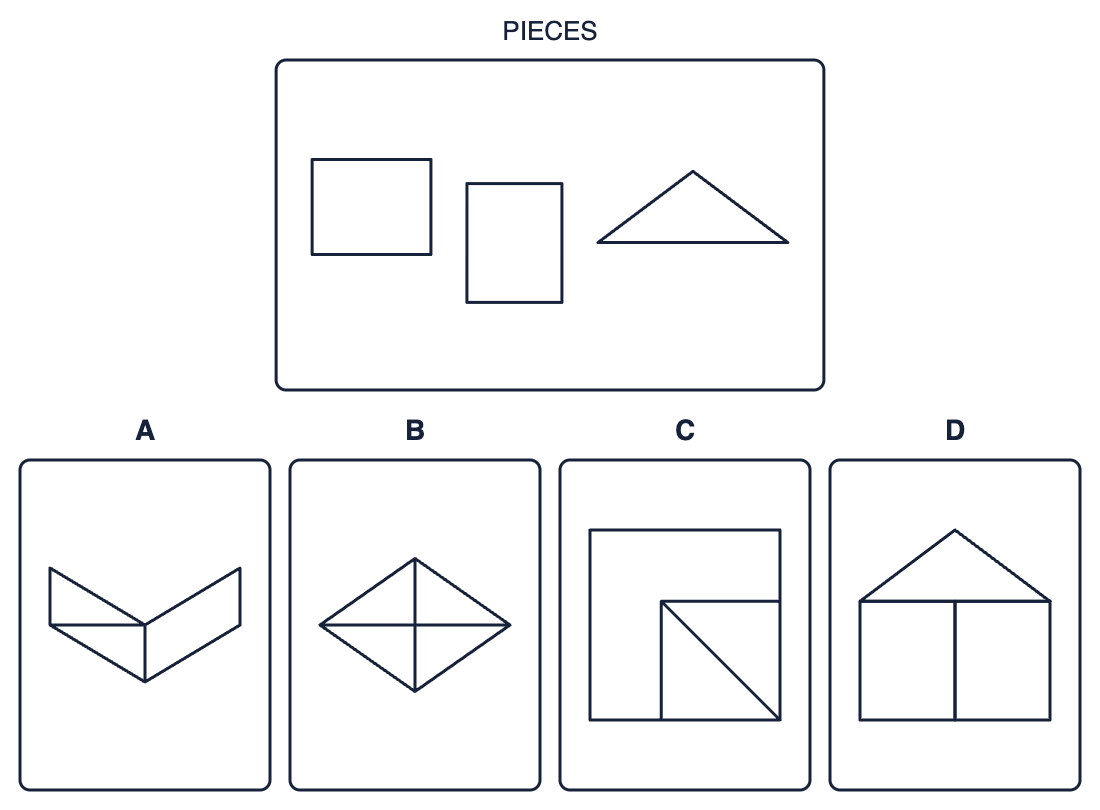
Refer to the figure (assembly puzzle 8). Which answer figure shows how the pieces in the box fit together?
Show answer
Answer: D. Figure D
The 3 pieces assemble into the house shape in figure D — every piece is used once, at its printed size, only rotated. Work from the largest piece: find the edge that matches its longest side, then check that the rest fill in without gaps or overlaps. The other figures are built from different pieces: even where an outline looks similar, the cuts inside don't match the pieces in the box.
-
AOAssembling Objects9 of 10
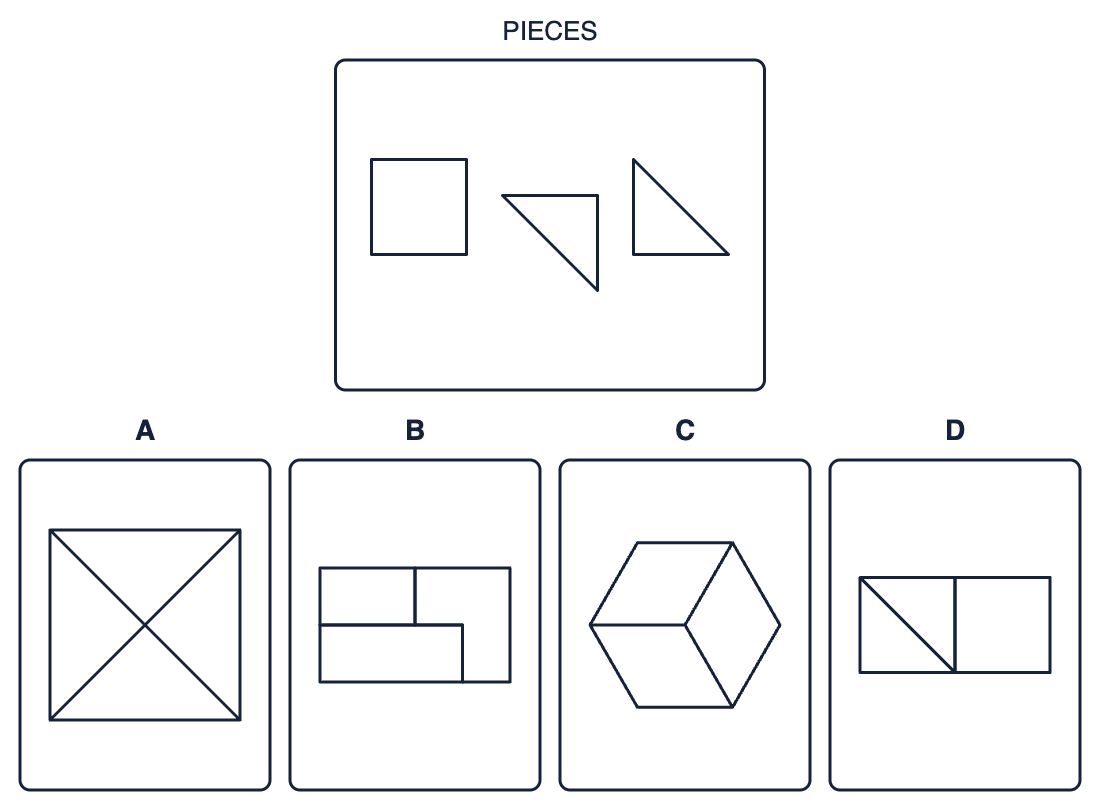
Refer to the figure (assembly puzzle 9). Which answer figure shows how the pieces in the box fit together?
Show answer
Answer: D. Figure D
The 3 pieces assemble into the rectangle in figure D — every piece is used once, at its printed size, only rotated. Work from the largest piece: find the edge that matches its longest side, then check that the rest fill in without gaps or overlaps. The other figures are built from different pieces: even where an outline looks similar, the cuts inside don't match the pieces in the box.
-
AOAssembling Objects10 of 10
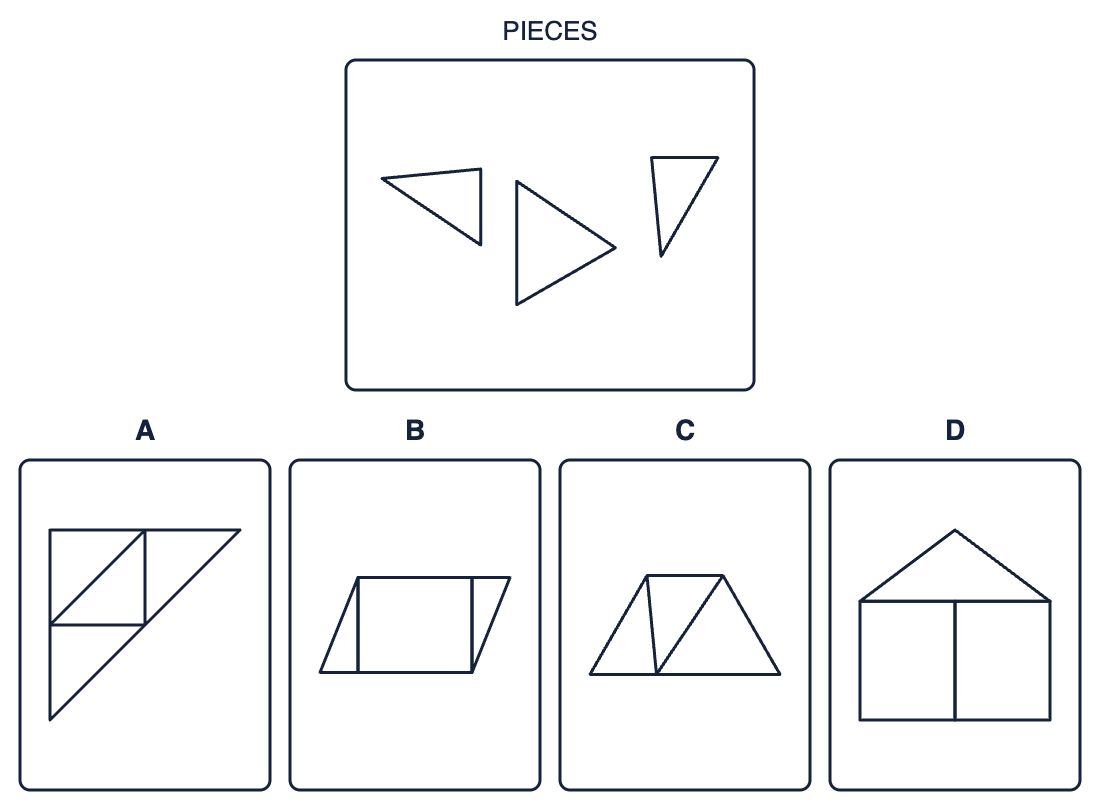
Refer to the figure (assembly puzzle 10). Which answer figure shows how the pieces in the box fit together?
Show answer
Answer: C. Figure C
The 3 pieces assemble into the trapezoid in figure C — every piece is used once, at its printed size, only rotated. Work from the largest piece: find the edge that matches its longest side, then check that the rest fill in without gaps or overlaps. The other figures are built from different pieces: even where an outline looks similar, the cuts inside don't match the pieces in the box.
What Assembling Objects covers
The facts and methods behind the questions, from the app's study notes. Questions on test day are different, but they test the same things.
Connection puzzles
Connection puzzles: join two shapes with a line at the labeled points, with everything rotated but never mirrored.
- One point at a time. Find point A’s exact corner on the first shape, then eliminate every option that attaches the line anywhere else. Repeat for B. Two eliminations usually leave one answer.
- Rotation yes, mirror no. Correct answers rotate the shapes freely but never flip them. If a shape could only match by mirroring — an L that bends the wrong way — that option is out.
- Expect disguise. The correct option is rotated on purpose so it looks least like the question box. Trust the labeled points, not the first-glance resemblance.
Assembly puzzles
Assembly puzzles: pick the figure the loose pieces form when fitted together, every piece used once at its printed size.
- Anchor on the biggest piece. Match its longest edge to the outline first; the leftovers must fill the remaining space without gaps or overlaps.
- Count and compare. Count the pieces, then check each option’s internal lines: same number of regions, same kinds of shapes. An outline can look right while its cuts are wrong.
- Size is fixed. Pieces never grow, shrink or mirror — only rotate. An option needing a stretched or flipped piece is eliminated instantly.
Keep going in the app. All 26 Assembling Objects questions, 26 of them with diagrams, practice that brings back the ones you miss, and full exams timed subtest by subtest like the real test.
Practice the other subtests
Or take the full free practice test: 30 questions from all 10 subtests, with a rough AFQT estimate at the end.
These are original practice questions; real ASVAB items are confidential. Practice scores are estimates, not official ASVAB scores. ASVAB Test is not affiliated with the U.S. Department of Defense or any military branch.