On this page
Short answer: Mechanical Comprehension (MC) gives you 15 questions in 22 minutes on the computer test, and most come down to a few rules. Meshing gears turn in opposite directions and the smaller one spins faster. A lever balances when weight times distance is the same on both sides. Every rope segment holding up a load shares its weight. MC doesn't count toward your AFQT, but it's part of the scores used for mechanical and technical jobs.
Mechanical Comprehension tests whether you can predict how simple machines behave: which way a gear turns, where a seesaw balances, how much force a pulley saves. You don't need to have fixed an engine. You need a handful of rules and the habit of picturing the machine moving, which is what the figures below are for.
Gears: direction and speed
When two gears mesh, their teeth push against each other, so they turn in opposite directions. Count teeth to get the speed: a gear with twice as many teeth turns half as fast.
- Driver 12 teeth, 60 rpm clockwise
- Output 24 teeth, 30 rpm counterclockwise
- Twice the teeth: half the speed, twice the turning force.
- Driver 12 teeth, 60 rpm clockwise
- Idler 18 teeth, 40 rpm counterclockwise
- Output 24 teeth, 30 rpm clockwise
- Same 12-to-24 ratio: the idler only flips the direction.
- Direction alternates down a chain. In a line of meshing gears, every other gear turns the same way: the first and third match, the second is opposite.
- Speed follows the teeth. The driven gear's speed is the driver's speed × driver teeth ÷ driven teeth. A 12-tooth gear driving a 24-tooth gear turns it at half speed.
- An idler only flips the direction. A gear in the middle doesn't change the speed ratio between the first and last gears. It makes the last gear turn the same way as the first.
- Slower means stronger. When a small gear drives a big one, the big gear turns slower but with more turning force (torque). That trade is why a low gear gets a truck up a hill.
- Same shaft, same turn. Gears fixed to one shaft turn together, at the same speed and in the same direction.
- Belts keep the direction. Two pulleys joined by an ordinary belt turn the same way; crossing the belt into a figure eight reverses one of them.
Levers: weight times distance
A lever balances when the weight on each side times its distance from the fulcrum (the pivot) comes out the same. Slide the 40-pound block until the beam levels out.
Left 80 lb × 3 ft = 240
Right 40 lb × 6 ft = 240
Balanced
The same rule tells you how much a lever helps. Its mechanical advantage is the effort distance divided by the load distance: push 4 feet from the fulcrum on a load 1 foot from it, and you need only a quarter of the force. The price is distance: your end moves four times as far as the load.
The three classes of lever
Questions sometimes ask which class a tool is. It depends on what sits in the middle:
| Class | In the middle | Examples | What it does |
|---|---|---|---|
| First | The fulcrum | Seesaw, crowbar, pliers | Can trade force for distance either way |
| Second | The load | Nutcracker, bottle opener | Always multiplies your force |
| Third | The effort | Tweezers, fishing rod, your forearm | Trades force for speed and reach |
Pulleys: count the ropes
A single fixed pulley only changes the direction you pull: you still pull with the full weight. Add pulleys that move with the load and the weight gets shared. Count the rope segments holding up the load, and that's your mechanical advantage.
- Ropes holding the crate
- 4
- Pull with
- 50 lb
- To lift it 1 foot, pull
- 4 ft of rope
Every advantage has its price in distance. With four supporting ropes you pull with a quarter of the force, but you pull four feet of rope for every foot the load rises. The work, force times distance, comes out the same, plus a little extra in real life to beat friction.
Ramps, screws and hydraulics
- Ramps (inclined planes): a longer ramp to the same height takes less force but more distance. The ideal mechanical advantage is the ramp's length divided by its height.
- Screws: a screw is a ramp wrapped around a post. Threads that are closer together take more turns to drive in, and less force per turn.
- Hydraulics: pressure is the same everywhere in a closed fluid, so force scales with piston area. A piston with four times the area pushes with four times the force, and moves a quarter as far.
Try five Mechanical Comprehension questions
Each one uses a rule from this page. The explanations show the working.
Your score
0/ 5
Practice scores from original questions, not official ASVAB scores. ASVAB Test is not affiliated with the U.S. Department of Defense.
-
MCMechanical Comprehension1 of 5
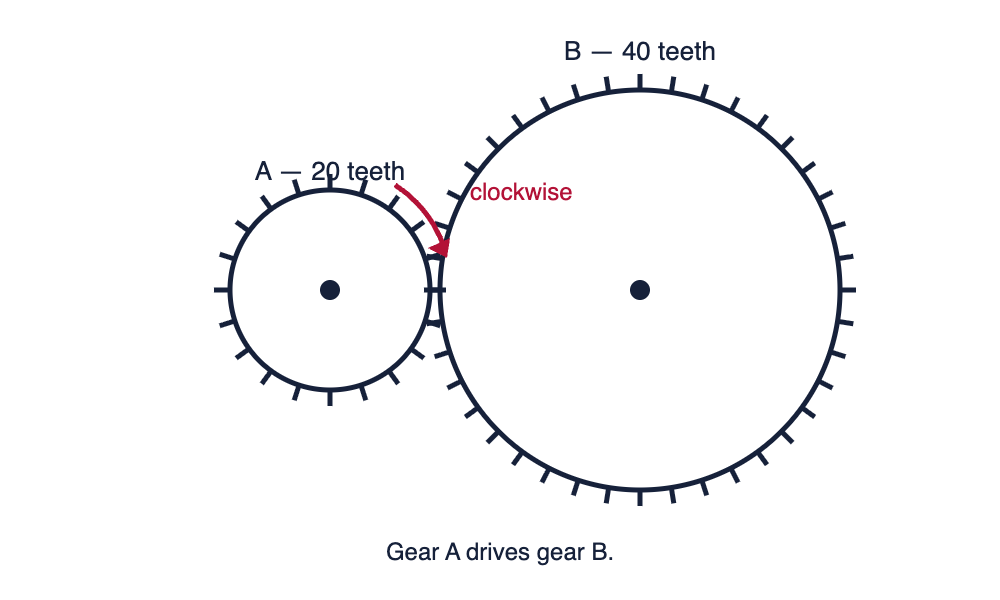
Refer to the figure. Gear A (20 teeth) meshes with gear B (40 teeth). If gear A turns clockwise, gear B turns:
Show answer
Answer: A. Counterclockwise, at half the speed of A
Meshed gears always turn in opposite directions. Speed is inversely proportional to teeth: with twice the teeth, B turns at half A's speed, but with twice the torque.
-
MCMechanical Comprehension2 of 5
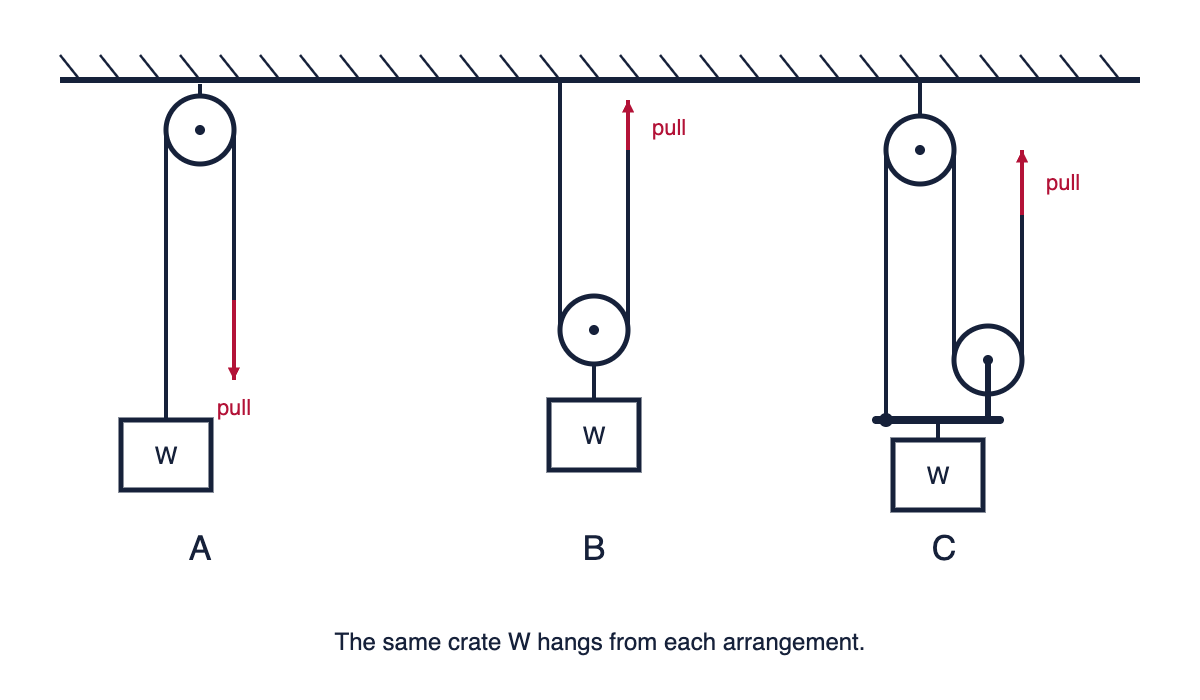
Refer to the figure. Arrangements A, B and C lift the same crate. Which setup needs the least pull on the rope?
Show answer
Answer: C. C, because more rope sections share the load
Mechanical advantage equals the number of rope sections supporting the load: A has one (it only changes direction), B has two, C has three. More supporting sections mean less pull — but more rope to haul.
-
MCMechanical Comprehension3 of 5
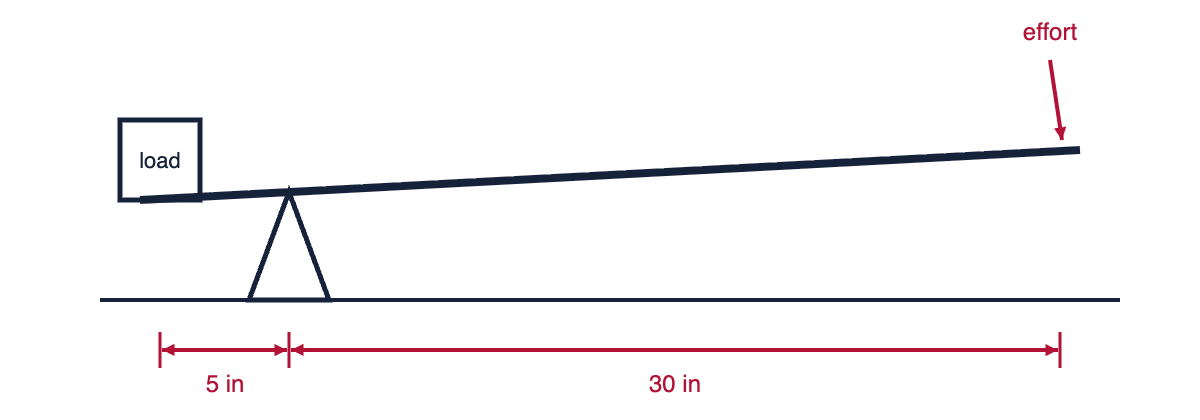
Refer to the figure. A pry bar is set so the distance from hand to fulcrum is 30 inches and from fulcrum to load is 5 inches. What is its mechanical advantage?
Show answer
Answer: C. 6
Mechanical advantage is effort arm ÷ load arm: 30 ÷ 5 = 6. A 50-pound push can move a 300-pound load — the long arm moves farther so the short arm pushes harder.
-
MCMechanical Comprehension4 of 5
A wheelbarrow is which class of lever?
Show answer
Answer: D. Second class — the load sits between the wheel (fulcrum) and your hands (effort)
Fulcrum at the wheel, load in the tray, effort at the handles: fulcrum-load-effort is a second-class lever, which always multiplies force. A seesaw is first class; tweezers are third class.
-
MCMechanical Comprehension5 of 5
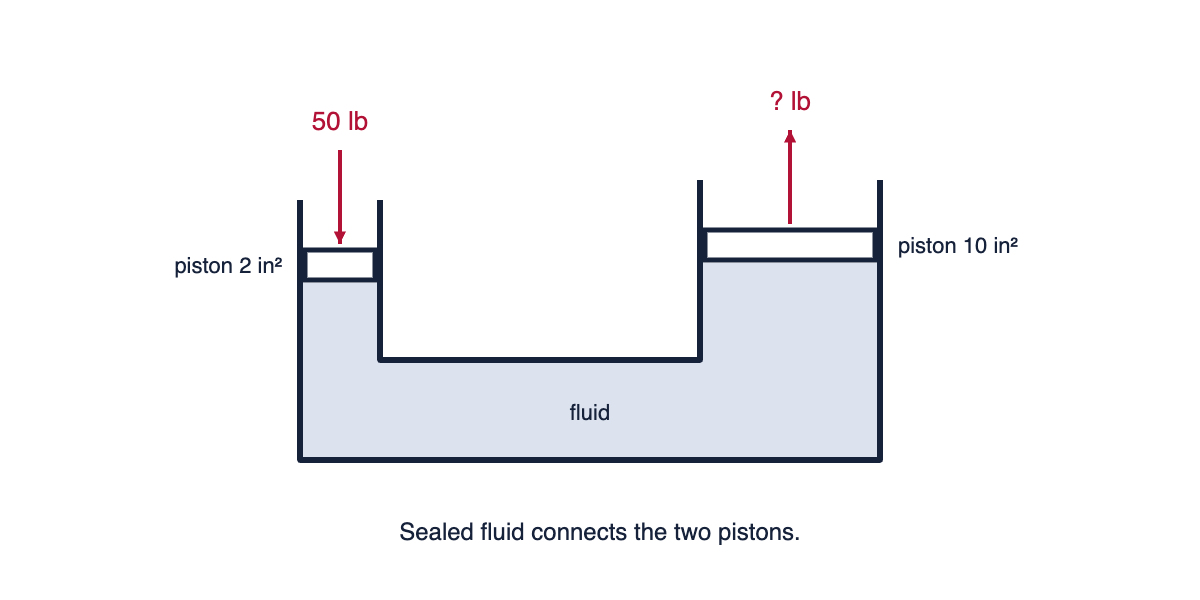
Refer to the figure. A hydraulic press has a 2-square-inch input piston and a 10-square-inch output piston. Pushing down with 50 pounds lifts how much on the output side?
Show answer
Answer: B. 250 pounds
Pressure transmits equally through the fluid (Pascal's principle): 50 ÷ 2 = 25 psi, and 25 × 10 = 250 pounds. The price is distance — the small piston must travel five times as far.
Quick answers
Does Mechanical Comprehension count toward the AFQT?
No. The AFQT uses only Arithmetic Reasoning, Mathematics Knowledge, Word Knowledge and Paragraph Comprehension. Mechanical Comprehension feeds the scores the services use for mechanical and technical jobs.
How many Mechanical Comprehension questions are on the ASVAB?
15 scored questions in 22 minutes on the computer test, and 25 questions in 19 minutes on the paper version.
Do you need physics formulas for Mechanical Comprehension?
Only a few simple relationships: weight times distance for levers, tooth counts for gear speed, rope segments for pulleys and piston area for hydraulics. Most questions reward picturing the machine moving more than calculating.
Sources
- OpenStax Physics, 9.3: Simple Machines (levers, pulleys, inclined planes, mechanical advantage)
- Official ASVAB: what to expect (what Mechanical Comprehension measures, its time limit)