On this page
Short answer: bring valid ID and arrive early; if you're late, you'll be turned away and have to reschedule. Most people take the computer-adaptive CAT-ASVAB at a MEPS or a Military Entrance Test site. It takes about 2 hours on average, each subtest has its own clock, calculators aren't allowed, and on the computer your scores are ready as soon as you finish.
Before test day
Your recruiter schedules the test, but first they'll ask about your health, education, marital status, any drug use and any arrests. Answer honestly: they're checking that you can enlist before spending a test slot on you. Some recruiters also have you take a short online predictor first, the AFQT Predictor Test: 20 adaptive questions from the four AFQT subtests that give the recruiter an estimate of your score.
You'll test at one of the 65 Military Entrance Processing Stations (MEPS) or at a smaller Military Entrance Test (MET) site, often in a federal building, a National Guard armory or a Reserve center. Your recruiter may give you a ride, but they can't come into the testing room.
First-time testers can sometimes take the PiCAT instead, a version without subtest time limits that you take online at home with an access code from your recruiter. If those scores look eligible, you'll go in for a short proctored verification test, about 25 to 30 minutes, within 45 days.
What to bring
- Valid identification. You won't be let into the testing room without it. Ask your recruiter which IDs count.
- Time to spare. Late arrivals are turned away and have to reschedule, so plan the trip with room for traffic.
- Nothing to calculate with. Calculators aren't allowed on any version of the ASVAB. You'll work on scratch paper.
- Rest. The official advice is to get plenty of sleep the night before. Cramming at midnight costs more than it earns.
How the session runs
On the computer, the session runs at your own pace. It opens with instructions on using the keyboard and mouse, which don't count against any clock. Then the ten subtests come in a fixed order, each with its own time limit. Finish one early and you move straight to the next; you don't wait for anyone else in the room. Tap through the session below.
ARArithmetic Reasoning
15 questions in 55 minutes, about 3:40 each. Counts toward your AFQT.
- The screen shows your clock. Time and questions remaining for the current subtest sit in the lower right corner.
- Answers lock. You can't go back to a question once you've moved on, so confirm each answer before you submit it.
- Some questions don't count. In 2 to 4 subtests you'll also get tryout questions being tested for future use, with extra time added. You can't tell which they are, so treat every question as real.
- Need something? Press HELP. The keyboard has a red HELP key for things like more scratch paper or another pencil, and the subtest clock stops while you're getting help.
- If the computer fails, nothing is lost. You restart on another computer at the beginning of the subtest you were on, with its clock reset.
The time limits are generous: almost everyone finishes each subtest before time runs out. If you don't, the questions you didn't reach count against you, which is why pacing beats rushing. Should you guess on the ASVAB? explains how blanks and guesses are scored.
When you get your scores
On the computer test, scores are ready right after your session: a score report with your AFQT and a standard score for each subtest. The paper version, given at a handful of test sites, is scored at the MEPS and usually takes a few days. Either way, your recruiter can walk you through what the scores mean for the jobs you want.
If you're testing at a MEPS, the ASVAB can be part of a longer visit that includes a physical exam. Ask your recruiter what your day includes and how long to plan for.
Nervous? Try this before you start
Feeling keyed up before a test is normal. Two things help most people:
- Make the format familiar. Take at least one full practice exam with each subtest on its own clock, so nothing about the day is new.
- Slow your breathing. A simple pattern is box breathing: in for four counts, hold for four, out for four, hold for four. A few rounds while you wait can take the edge off.
Ready when you are
A warm-up round
Five questions from the subtests people forget to practice: science, electronics, auto, shop and assembling objects. They're in the same order you'll meet them on test day.
Your score
0/ 5
Practice scores from original questions, not official ASVAB scores. ASVAB Test is not affiliated with the U.S. Department of Defense.
-
GSGeneral Science1 of 5
In the water cycle, what is the process called when liquid water becomes water vapor?
Show answer
Answer: A. Evaporation
Evaporation turns liquid water into vapor, usually powered by the Sun. Condensation is the reverse (vapor to liquid, forming clouds), precipitation is rain or snow falling, and infiltration is water soaking into the ground.
-
EIElectronics Information2 of 5
What is the purpose of a fuse in a circuit?
Show answer
Answer: D. To melt and break the circuit when current gets too high
A fuse contains a thin metal strip that melts when current exceeds its rating, opening the circuit before wiring overheats. A blown fuse must be replaced; a circuit breaker does the same job but can be reset.
-
AIAuto Information3 of 5
While the engine is running, what charges the battery?
Show answer
Answer: B. The alternator
The alternator is a belt-driven generator that powers the vehicle's electronics and recharges the battery while the engine runs. The starter is the opposite: it drains the battery to crank the engine.
-
SIShop Information4 of 5
Before driving a large wood screw near the end of a board, you should drill a pilot hole to:
Show answer
Answer: C. Prevent the wood from splitting
A pilot hole slightly smaller than the screw's core lets the threads bite without wedging the wood fibers apart. Near an edge or end, skipping it commonly splits the board.
-
AOAssembling Objects5 of 5
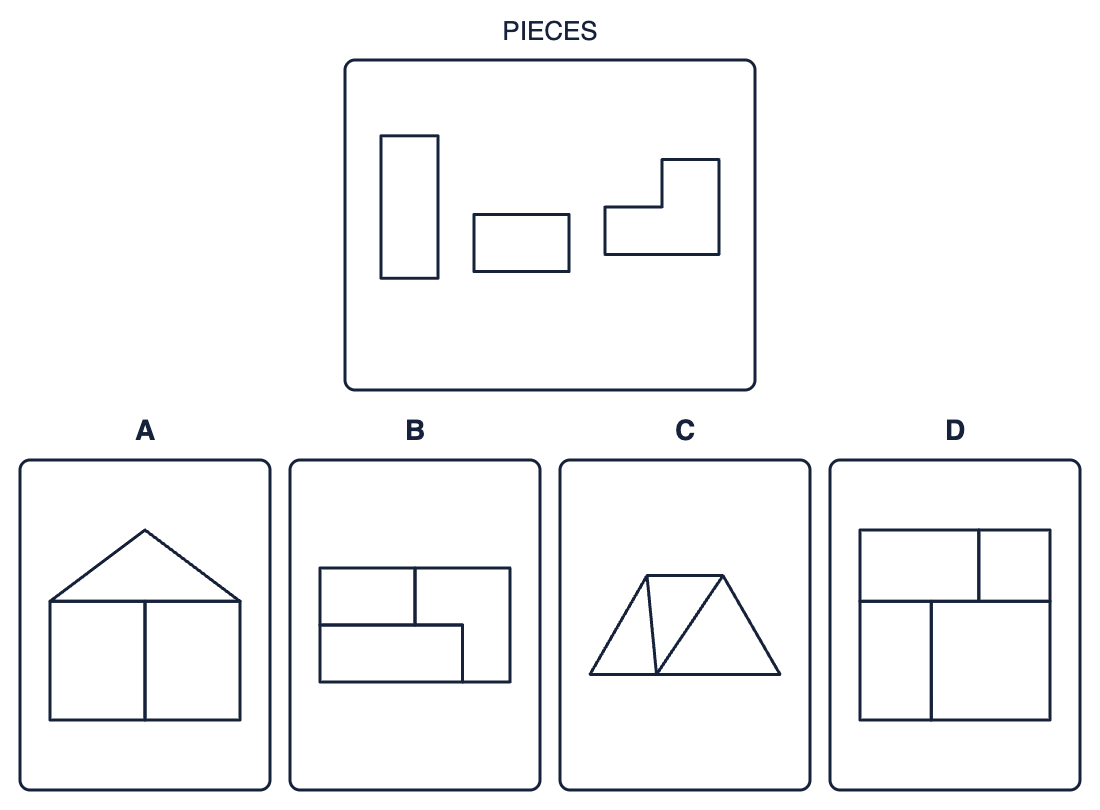
Refer to the figure (assembly puzzle 3). Which answer figure shows how the pieces in the box fit together?
Show answer
Answer: B. Figure B
The 3 pieces assemble into the rectangle in figure B — every piece is used once, at its printed size, only rotated. Work from the largest piece: find the edge that matches its longest side, then check that the rest fill in without gaps or overlaps. The other figures are built from different pieces: even where an outline looks similar, the cuts inside don't match the pieces in the box.
Quick answers
How long does the ASVAB take?
About 2 hours on average for the computer version. The paper version takes 3 to 4 hours, including instructions.
Can your recruiter come into the testing room?
No. Your recruiter can drive you to the session but isn't allowed in the testing room.
What happens if you're late for the ASVAB?
You'll be turned away and have to reschedule, so leave extra time for the trip.
Is the ASVAB given in Spanish?
No. The ASVAB is only given in English, because every service member needs to be able to work in English.
Sources
- Official ASVAB: what to expect (screening, MEPS and MET sites, ID, lateness, the session, PiCAT)
- Official ASVAB: the CAT-ASVAB for recruiters (the HELP key, untimed instructions, computer failures, score reports)
- Official ASVAB: the CAT-ASVAB (time limits and unfinished subtests)
- Official ASVAB: the AFQT Predictor Test
- Official ASVAB: preparing for the ASVAB (rest the night before)